You are currently viewing How Does Ignition Happen? Tree Care & Fire Safety

How Does Ignition Happen? Tree Care & Fire Safety

Most Sonoma County homeowners have lived through at least one bad fire season. You’ve seen the smoke. You’ve packed a go-bag. Maybe you’ve watched a fire come closer than anyone wanted.

The question that stays with people every year is the same: how do these fires actually reach a house, and what can you do on your own property to reduce its vulnerability?

This guide walks through the real mechanics of wildfire ignition and how tree care and fire defensible space services can change outcomes.

Key Takeaways

  • Most homes lost in California wildfires are ignited by wind-blown embers, not direct flame contact.
  • Embers can travel a mile or more ahead of a fire front.
  • Trees, shrubs, and grass form a continuous fuel path that moves fire from the wild edge to a structure.
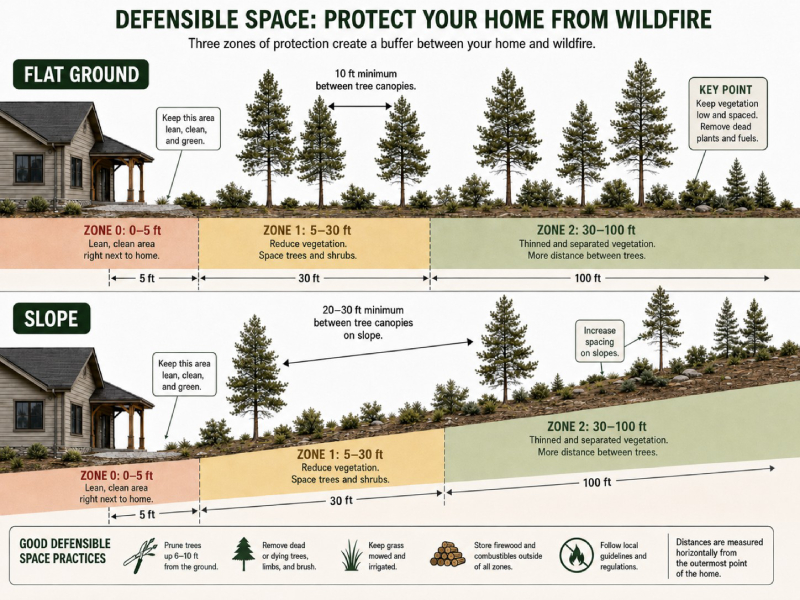
  • Defensible space is organized into 3 zones, each with different rules for spacing, pruning, and ground cover.
  • Fire defensible space services from a certified arborist address the tree side of that fuel path.
  • Sonoma County’s mix of oak woodland, conifer, and annual grassland makes property-specific planning important.

How Wildfire Ignition Begins

Wildfire reaches a home in 3 main ways. Understanding each one changes how you read your own property.

Embers: The Largest Risk

Research from CAL FIRE and the Insurance Institute for Business and Home Safety shows embers cause the majority of home losses in wildland fires. Wind carries burning fragments of bark, leaves, and pine needles well ahead of the main fire. Those embers land on roofs, in gutters, against fences, in vent openings, and in dry vegetation up against the house.

A single ember in dry leaves under a deck can start a fire hours before the flame front arrives. That is why neighborhoods miles from the official fire perimeter still burn.

Direct Flame Contact

When flames touch a structure or a fuel that touches the structure, ignition can happen within minutes. The common path runs from grass to shrub to low tree branch to siding or eave. Each step shortens the distance between wild fuel and the home.

Radiant Heat

Large flames give off enough heat to ignite wood, melt window seals, and crack glass from across a yard. A burning oak 30 feet from a wall can preheat that wall to ignition temperature without any flame contact. Windows that fail let embers inside, and the fire moves to the interior.

Trees and Vegetation Are High Risk

Sonoma County has dense oak woodland, redwood and Douglas fir stands, and dry annual grasses. That mix creates 2 fire behaviors property owners need to know about.

Ladder fuels are anything that lets fire climb from the ground into a tree canopy. Dry grass, low shrubs, deadwood, and low branches all act as rungs. A grass fire that hits a tree with low branches can become a crown fire in seconds.

Canopy continuity is what happens when tree crowns touch or sit close together. Fire moving through a continuous canopy travels faster, throws more embers, and is harder to stop. Spacing tree crowns reduces both the speed and the ember load.

What Homeowners Can Do

You can’t change the weather, the slope, or your neighbor’s yard. You can change the fuel within your property line. California defensible space law and Sonoma County guidance both organize the work in zones.

Zone 0: 0 to 5 feet from the structure

This is the ember zone. Keep it clear of anything that can ignite.

  • Remove dead leaves, pine needles, and bark mulch against the foundation
  • Cut back branches that touch or overhang the roof
  • Clear vegetation under decks and clean out gutters
  • Move firewood, planters, and door mats away from walls during fire season

Zone 1: 5 to 30 feet from the structure

This is the lean, clean, and green zone.

  • Prune lower tree branches to at least 6 feet from the ground, higher for taller trees
  • Keep tree crowns at least 10 feet apart in this zone
  • Remove dead branches and ladder fuels in remaining shrubs
  • Replace dry annual grass with irrigated lawn or low-fuel ground cover

Zone 2: 30 to 100 feet from the structure

Reduce fuel volume and continuity without clear-cutting.

  • Space tree crowns based on slope (steeper slopes need wider spacing)
  • Remove dead, diseased, and dying trees
  • Thin understory shrubs and remove ladder fuels under healthy trees
  • Keep grass mowed to 4 inches or less
Defensible Space Services

When to Bring in Fire Defensible Space Services

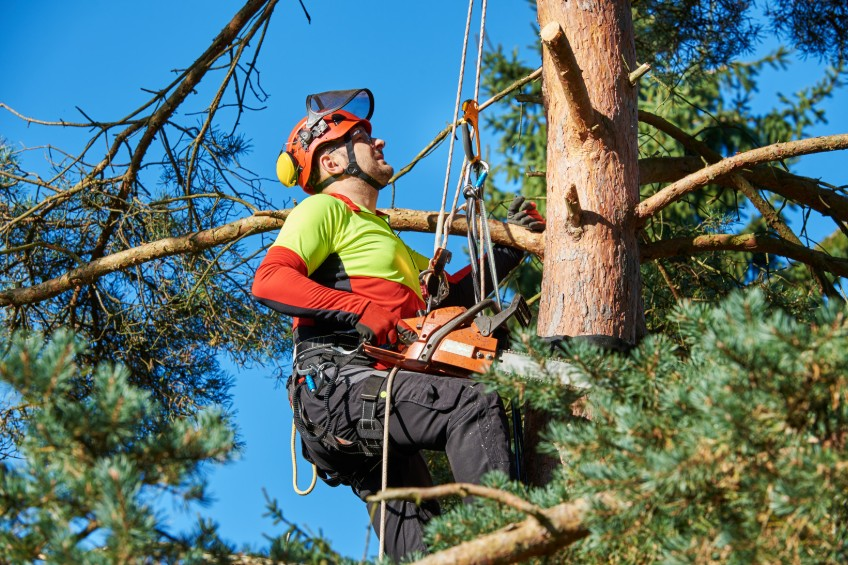
Some work a homeowner can handle with a rake and a pole pruner. Other work is risky, technical, or governed by tree ordinances. Fire defensible space services from a certified arborist are worth calling in when:

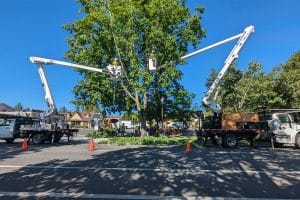
  • Trees are tall enough that pruning needs ropes or a lift
  • Branches overhang the roof or sit near power lines
  • A tree is dead or declining and needs removal
  • Heritage oaks or other protected species are involved and a permit may apply
  • Nesting birds are active and federal law applies
  • A whole property needs a fuel reduction plan, not just one tree

A poorly pruned tree can become more vulnerable to disease and structural failure. Pruning for fire resiliency follows the same ANSI A300 standards as any other professional pruning. Cuts in the wrong place cause long-term damage.

Get a Defensible Space Assessment for Your Property

Sandborn Tree Service has cared for Sonoma County trees for over 50 years. Our team includes ISA Certified Arborists and Sonoma County Board Certified Master Arborists who plan fuel reduction with tree health in mind.

On a property, that looks like:

  • A walk-through with an estimator who reads slope, species, spacing, and structures together
  • A written proposal that ties each recommendation to a zone and a reason
  • Pruning that meets ANSI A300 standards, no flush cuts and no topping
  • Ladder fuel removal and canopy spacing that keeps shade, humidity, and tree health intact
  • Help with permits when local ordinances apply
  • Biomass recycled into mulch, compost, or milled wood when usable

The goal is a property with lower fire intensity potential and trees that stay healthy for the next 50 years. Call Sandborn Tree Service at (707) 823-9144 or contact us online to schedule an arborist visit.

Frequently Asked Questions

What's the difference between defensible space and home hardening?

Defensible space deals with vegetation and ground around the structure. Home hardening deals with the structure itself, including roof material, vents, siding, and windows. Both matter, and they work together.

Annual maintenance is the standard. Grass grows back. Leaves drop. Branches extend. Most Sonoma County properties need a full review every spring and spot work after windy weather.

Some of it, yes. Clearing gutters, raking leaves, and mowing grass are homeowner tasks. Pruning above shoulder height, removing trees, or working near power lines should go to a certified arborist for safety and tree health reasons.

Not always. our team’s first priority is preservation. Trees come out when they’re dead, declining, too close to a structure, or unsuitable for the location. Many properties reach good defensible space through pruning and spacing alone.

Sometimes. Sonoma County and many cities have tree ordinances that apply to certain species and sizes. Sandborn can identify what needs a permit and handle the paperwork.

Leave a Reply